 广告


Zhibai · October 28, 2026
On the evening of October 27, China's public mutual funds finished filing their Q3 reports.
If you open your fund app right now, scroll to "top ten holdings," you'll probably do a double take.
No Moutai. No China Merchants Bank. No Ping An.
Sitting at number one is a company called Zhongji Innolight. What do they make? Optical modules — the "light wiring" inside AI data centers.
Look at the list
The new top-ten holdings across the entire public fund industry, ranked by market value held:
Zhongji Innolight, Eoptolink, WuXi AppTec, ChangXin Memory, Yuanjie Semiconductor, Dongshan Precision, CATL, Cambricon, NAURA, and WUS Printed Circuit.
Count them. Eight of these ten are directly tied to AI compute — optical modules, memory chips, AI chips, PCB, semiconductor equipment.
The only "non-AI" names are WuXi AppTec and CATL.
Ten years ago, the biggest holding across China's public funds was Kweichow Moutai. Back then the joke was that China's fund managers were just "Moutai retail investors with a license."
Ten years later, Moutai isn't even in the top ten. Replacing it are a bunch of companies you'd be hard-pressed to name.
1,557 funds crammed into one stock
What really caught my eye isn't the list itself. It's the numbers underneath.
Zhongji Innolight is held by 1,557 separate funds, with a total position of RMB 95.9 billion, equal to 10.12% of its free float.
Eoptolink is held by 1,189 funds, RMB 87.1 billion — 17.84% of its free float.
Let that sink in.
Nearly one out of every five tradable Eoptolink shares is sitting in a public fund's hands. More than a thousand funds, hundreds of billions in capital, all parked on the same trade.
That is not "diversification."
That is herding.
Watch the rotation too. New entrants to the top ten: WuXi AppTec, ChangXin Memory, WUS Printed Circuit. Dropping out: GigaDevice, AMEC, Three-Circle Group.
Translation: managers haven't given up on tech. They're rearranging seats within tech — out of some already-rip chip design names, into memory, PCB, optical modules — the "picks and shovels" of the AI gold rush.
Even the old-school value guy Fu Pengbo added 83% more Innolight in Q3.
The most disciplined long-term investors are all rushing into AI.
The upside — and the bill
Herding isn't new.
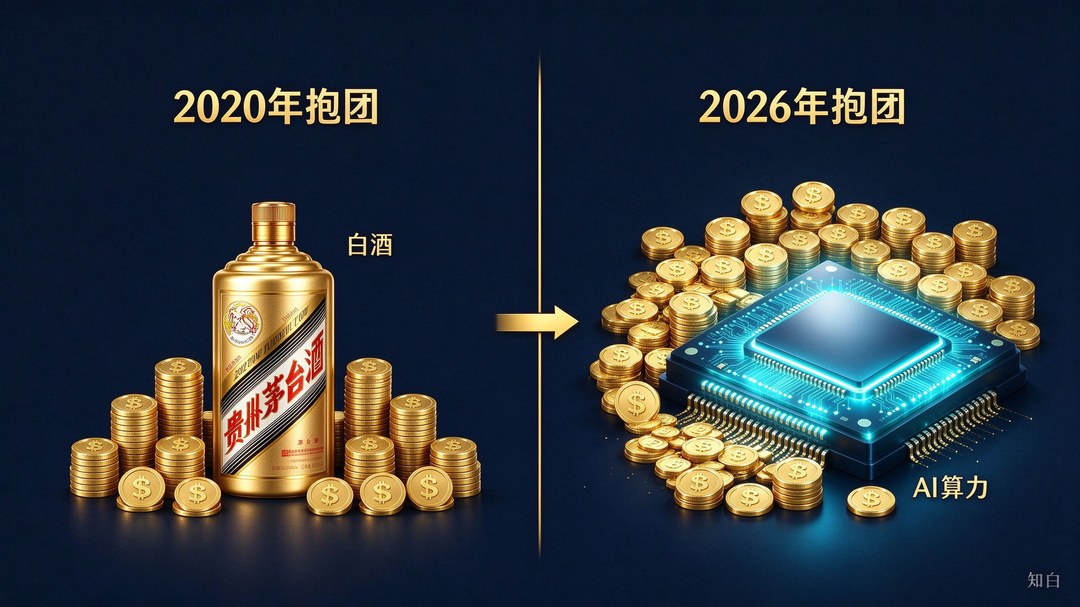
In 2020 it was baijiu. In 2021 it was EVs. In 2023 it was "China Special Valuation." Every cycle, the smartest people in the market pile the same few stories together.
There's a logic to it.
This AI wave isn't vapor — the earnings at companies like Innolight are real. NVIDIA has multiples its revenue, Microsoft, Google, Meta all have capex numbers written in plain sight. Compute demand is hard. Optical module orders are real. Fund managers aren't buying blindly.
But here's the thing: when a consensus becomes the common position of 1,557 funds, it stops being an opportunity and becomes a risk.
Do the math.
17.84% of Eoptolink's float is in public funds. What happens when the AI narrative wobbles — if NVIDIA misses, if US export rules tighten again, if one bellwether posts a soft quarter? The first sellers hit the bid. The later ones find the door is already too narrow.
Over a thousand funds, hundreds of billions in chips, all trying to leave through the same exit at once.
The door breaks.
That's what "crowded trade" means. On the way up everyone makes money. On the way down, you step on each other.
Flash back to 2020. Moutai was the top holding then, half the top twenty was baijiu. Managers wrote in their annual letters about "good tracks, good companies, good prices." Retail piled into baijiu ETFs at a premium. Then what? After the 2021 Spring Festival, Moutai went from 2,600 to 1,300. In three months. The people writing those earnest annual letters were the first to run.
History doesn't repeat. It rhymes.
AI today looks uncomfortably similar structurally to baijiu then: real earnings, full-market consensus, hundreds of billions crammed into a handful of names, the loudest voices saying "this time is different."
There are differences — the AI cycle is longer, global capex is still expanding, NVIDIA's numbers haven't cracked. But the arithmetic doesn't change: when everyone is on the same side, there are no more marginal buyers.
Why this matters to your wallet
Three things for ordinary people.
One, stop thinking "mutual fund = safe investing." You think you own a diversified basket. Your fund manager probably bought the same Innolight as the manager next door. You thought you diversified — you actually doubled down.
Two, look past the return number, look at the holdings. If a fund's top ten are eight AI-compute names, it's an "AI themed fund" in disguise — it just markets itself as "balanced growth." Its moves will track the AI sector. Don't discover what you own after it's already gone up a year.
Three, be suspicious of "institutional herding" itself. History says when public funds crowd into a sector, you're usually in the middle-to-late innings. Not calling a top — earnings are there, capex is there. But when all the smart money is on the same side, the question isn't "how much higher?" It's "if it falls, who gets out first?"
Four, open your fund app right now. Tap "holdings." Look at the top ten. If eight of them are the names above, you're not dollar-cost-averaging a balanced portfolio. You're DCA-ing the AI sector. That's fine — but know it. If AI pulls back 30% over the next six months, your NAV will follow. Know that before you blame your manager for "not being professional."
One last thing: I'm not calling the AI top. Optical orders are real. Domestic memory substitution is real. NVIDIA's earnings are real. Industry trend is industry trend. Crowded positioning is crowded positioning. They're not the same thing — and a great stock at a crowded level can still lose you money.
This is a financial observation, not investment advice. Markets carry risk. Do your own homework.
Sources
1. Shanghai Securities News, Securities Times, China Securities Journal (Oct 28): Q3 2026 public fund reports; new top-ten holdings.
2. Shanghai Securities News: ChangXin Memory becomes 4th largest holding; Innolight held at RMB 95.9bn (10.12% of float); Eoptolink 17.84% of float.
3. Gelonghui (Oct 27): WuXi AppTec, ChangXin Memory, WUS PCB enter top ten; GigaDevice, AMEC, Three-Circle drop out.
4. Tencent Finance (Oct 28): Fu Pengbo increases Innolight position by 83%+.