 广告


Zhibai · November 2, 2026
Tonight, my phone blew up.
"The PBoC just dropped the bazooka. Sept 24 all over again."
"800 billion in fresh liquidity. Load up tomorrow at the open."
"National team is in. This time is different."
I spent half an hour reading the official releases, then dug up the old files from two years ago.
Here's the unpopular take: this is not a new bazooka. It's the same toolkit from two years ago, upgraded from a "pilot program" to a "permanent facility," with the loan rate trimmed by 25 basis points.
What actually happened tonight
Get the facts straight before the emotions carry you away.
On November 2, Chinese financial regulators held three meetings in a single day.
The first: the PBoC and CSRC gathered brokerage and fund companies to discuss "pushing the capital-market support tools into use." The second: the PBoC, NFRA and CSRC brought major banks in to "optimize the stock buyback and stake-increase relending facility."
Three hard points from the official readout:
The stock buyback and stake-increase relending facility shifts from a temporary arrangement to a permanent institutional arrangement. Its lending rate drops from 1.25% to 1%.
The Securities and Fund Exchange Facility (SFF) — colloquially the "swap window" — keeps operating, with more eligible institutions, lower swap fees, and improved collateral rules.
Major state banks are set to extend tens of billions of yuan in new dedicated credit lines to China Reform and China Chengtong — each platform getting on the order of 100 billion.
That's it.
No new trillion-yuan stimulus. No RRR cut. No rate cut. No direct handouts to listed companies.
What you got was a two-year-old "firefighting" toolkit, now stamped "permanent," and the cost of borrowing through it trimmed by 25bp.
The money doesn't land in your account first
Most people see "hundreds of billions" and "relending" and immediately think: money's coming, what do I buy tomorrow?
Slow down.
Look at those two names — China Reform and China Chengtong.
Both are state-owned capital operating companies under SASAC. The market calls them the "national team platforms." They stepped in during the 2015 crash, and again in September 2024.
The new credit lines from the big banks go to these two platforms. They then use the money to buy stocks, buy ETFs, and support central-enterprise buybacks in the secondary market.
Translation: the money's first stop is the national team's account, not yours.
There are several layers in between.
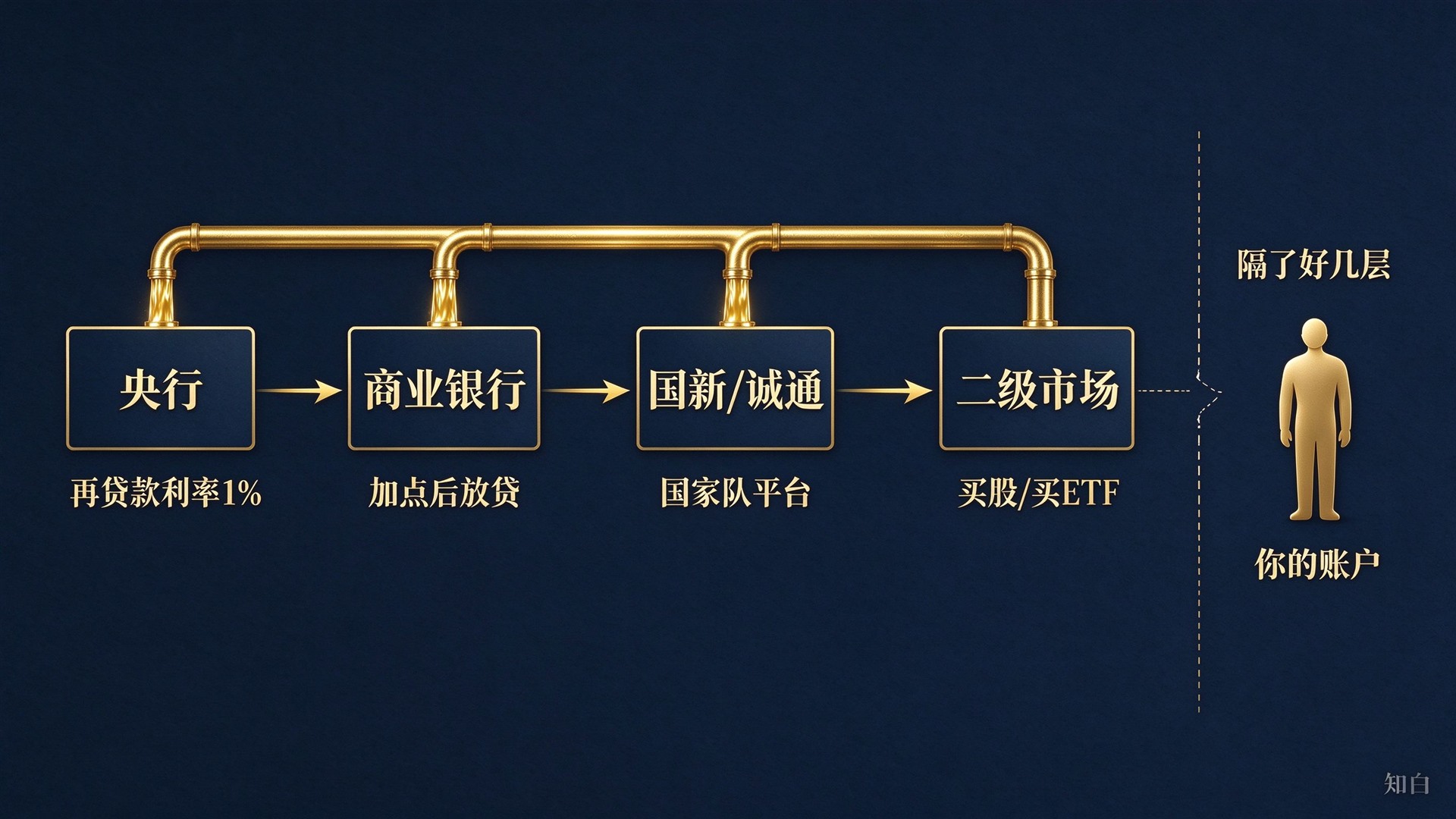
Layer one: the central bank lends to commercial banks at 1%. Layer two: banks add a spread and lend to Reform and Chengtong. Layer three: those platforms deploy the capital into equities and ETFs. Layer four: retail sentiment catches up and follows.
By the time you "feel" this money, it's been filtered through three layers. It will lift the index, stabilize blue chips, give central enterprises buyback ammunition — but it won't directly become the floating P&L in your brokerage account.
Do the math more carefully.
The 1% relending rate is what the central bank charges commercial banks. The banks don't pass that 1% through to the platforms — they add a spread. Reform and Chengtong's actual cost of capital lands around 1.5%. These aren't charitable vehicles; they're state capital platforms that have to earn a return.
Which means: they'll step in when stocks are cheap enough to offer a margin of safety. Not when you're FOMO-ing into a headline.
History is more honest than the press release
I know someone's about to invoke September 24, 2024.
That night, three regulators held three meetings in one day and unveiled the SFF and the relending facility. The Shanghai Composite rallied from 2,700 to 3,300 in a week. Hong Kong exploded.
Everyone was screaming "new bull market" that night.
Then what?
From the October 9, 2024 peak, A-shares gave back much of that rally over the next three months. People who chased 3,300 were stuck for nearly a year.
History doesn't repeat. But it warns you: between the "policy bottom" and the "market bottom," there's often a long, uncomfortable stretch.
Tonight's move is far milder than 2024.
Back then, the tools were being created from zero. Nobody knew how big they could get or how they'd work. The imagination ran wild. It was a pure expectation gap.
Today? These two tools have existed for two years. The market knows how they work, what the size was last time, where the leverage went. Tonight just swapped "temporary" for "permanent" and cut the rate from 1.25% to 1%.
The people who needed to know already know. The market already priced it in during the day session.
What's left is waiting to see when the actual money moves.
How to read tonight's news
Three things for ordinary people.
One, don't mistake "institutionalized" for "the market's green light." A permanent backstop is a safety net, not a starting gun. It tells you someone is underneath — it doesn't tell you to load up tomorrow.
Two, watch two signals. First: when, and in what form, the 100-billion-plus lines to Reform and Chengtong actually show up in the market. Second: whether listed-company buyback announcements spike over the next one or two months. A tool on paper is just paper.
Three, look at your own positions again. If you've been sitting on losses for two months, tonight's headline isn't a reason to add leverage — it's a reason to ask yourself honestly: are you investing for the long run, or are you betting on a policy rumor?
I'm not bearish.
The backstop is real. The long-term capital is real. The regulators' desire to steady the market is real. But I've seen too many people read "policy support" as "rip-roaring rally starts tomorrow" and then chase the exact wrong price.
Backstop means "there's a cushion underneath." It doesn't mean "we're going to the moon tomorrow."
This is a financial observation, not investment advice. Markets carry risk. Do your own homework.
Sources
1. CCTV News, Shanghai Securities News (Nov 2): PBoC, NFRA, CSRC hold symposium on capital-market support tools.
2. Sina Finance (Nov 2): Buyback relending becomes permanent, rate cut from 1.25% to 1%; major banks to extend ~100 billion dedicated credit lines each to China Reform and China Chengtong.
3. Xinhua (Sept 24, 2024): Initial launch of the SFF and stock buyback relending facility (historical reference).
4. Securities Times (Oct 30): CSRC pledges "all-out effort to stabilize markets and expectations."